KS Ghostform is a free synth for slow harmonic drift and cinematic drone beds
sapi_44530a
October 6, 2026
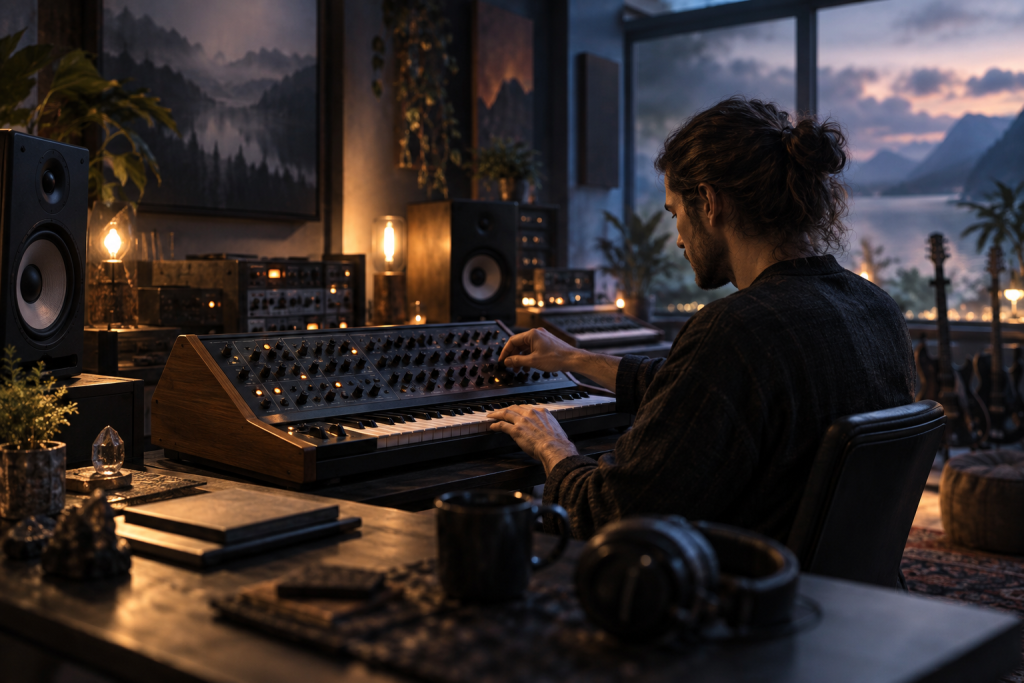
Some synths are built to be played. KS Ghostform is built to be waited on. You load it, hold one note, and then you just sit there while a chord slowly pulls itself apart into something you did not quite ask for. That is the whole idea. It is a free instrument aimed squarely at slow harmonic drift and long cinematic drone beds, and in a market stuffed with capable free synths (Vital, Surge XT, Odin2), it earns its place by doing one very specific job instead of trying to do everything.
If you make ambient, downtempo, dream-pop, or anything that lives or dies on sustained texture, this one is worth the download. If you need a workhorse, close the tab.
What Ghostform actually is
Ghostform is a free synth from KS (Klevgrand-affiliated? No, to be clear: I will not guess the developer lineage here). The name is the giveaway. Ghostform is about motion that you do not consciously trigger: a note that wanders in pitch, a harmony that smears into the next one, a drone that never repeats exactly. It is not a subtractive synth with an “ambient” preset folder bolted on. The design leans into drift as the primary feature, not the garnish.
That is a meaningful distinction. Most free synths in 2026 treat ambient as one preset category among many. Vital, for instance, is a wavetable powerhouse that handles everything from trap to cinematic leads with equal indifference. Surge XT covers wavetable, FM, additive, and virtual-analog in one open-source package. Odin2 gives you semi-modular analog modelling with Moog-ladder and Korg-35 filter emulations. All three are excellent. None of them are built around the idea that the note you hold should become a different note by the time you let go.
Ghostform is. That is its reason to exist.
Why harmonic drift matters for drone beds
A drone bed that does not move is a pad. A drone bed that moves slowly enough that you cannot tell it is moving is atmosphere. The difference is in the timescale. When a chord shifts over two bars, you hear it as a chord change. When it shifts over sixteen bars, you hear it as a mood change. Ghostform sits in that second pocket.
In practice, this changes how you write. You stop thinking about chord progressions and start thinking about harmonic fields. You place a root, let it breathe, and then introduce a second voice that drifts into a fifth or a fourth over the course of a minute. The listener never clocks it as a movement. They just feel that the room got bigger, or colder, or sadder. That is the trick ambient producers spend years chasing, and Ghostform gives you a tool that makes it almost automatic.
For a downtime or lo-fi context, this is gold. You can lay a Ghostform drone under a beat and the bed will do the emotional work without ever competing for attention. For cinematic work, it gives you a sustained tone that behaves like a string section playing a very slow glissando, except it costs nothing and takes up almost no CPU on a modern machine.
Where it sits in a dreamy workflow
Here is how I would actually use it. One instance, held note, long attack, no LFO on the amp. Let the oscillator drift do the movement. Print it to audio at 30 seconds, then reverse the tail and layer it underneath itself. That gets you a swell that feels like it came from somewhere else, which is exactly what a cinematic drone bed needs.
For dream-pop, the angle is different. Ghostform is a great sub-layer under a bright pad. You let the pad carry the melody and the Ghostform instance carry the uncertainty. It is the sonic equivalent of a background vocal that is slightly out of tune on purpose. That is a texture you cannot fake with a detune knob, because detune is static and drift is not.
Paired with something like Valhalla Supermassive or VintageVerb, it becomes dangerous in the best way. You can send it 100% wet and it still reads as an instrument rather than a wash, because the harmonic content is actually changing underneath the reverb. Most pads go to mush in a long reverb tail. Ghostform stays legible, which is a real technical advantage for anyone building endless ambient tails.
What it is not
Ghostform is not a melodic synth. Do not try to play a lead on it. The drift makes pitch accuracy a moving target, and that is by design. If you want a melody, use Vital or Diva or Pigments. If you want a pad with a clear top note, use something else. Ghostform’s whole personality is that it refuses to sit still long enough for you to judge its intonation.
It is also not a sound design playground in the Odin2 sense. There is no deep modulation matrix to get lost in. That is a feature, not a bug, but it means the instrument has a ceiling. You will get one flavour from it, maybe two if you push the parameters hard. For a free plugin, that is a fair trade. For a daily driver, it is a limitation you should know about before you download it.
The interface is also, frankly, minimal. If you are used to the real-time visual feedback of Vital or the dense layout of Surge XT, Ghostform will feel almost empty. That is fine for what it does. It is not fine if you like to see your modulation move.
Free synth landscape, honestly
The 2026 free plugin market is genuinely absurd. Tools that cost hundreds a few years ago are now free, and they are not stripped-down demos. Vital remains the single most important free synth available, with three wavetable oscillators, a sampler, dual filters, and a modulation matrix that matches Serum in most practical scenarios. Surge XT ships with over 2,000 factory presets and covers wavetable, virtual-analog, FM, string, twist, and windowed sync modes. Odin2 from TheWaveWarden is a semi-modular analog-modelled synth with unusually thorough documentation and filter emulations that have real character.
Against that lineup, a one-trick drone synth has to justify itself. Ghostform does, because none of those three are designed around slow harmonic drift. You can approximate it in Vital with a slow LFO on fine tune and a long envelope. You can approximate it in Odin2 with a modulation matrix. But you will spend twenty minutes patching what Ghostform does out of the box, and you will probably not get the same feel. The convenience is the value.
Verdict
Download it if you make ambient, drone, cinematic bed music, or slow dream-pop. Use it as a texture layer, print it to audio, and let it do the emotional work under your composition. Do not expect it to be your main synth, and do not judge it on features it was never trying to have.
It is free, it is focused, and it does one thing that most synths do not. For a drone bed, that is enough.