u-he Diva Review: Still the Warmest Analog Pads Money Can Buy
sapi_44530a
September 27, 2026
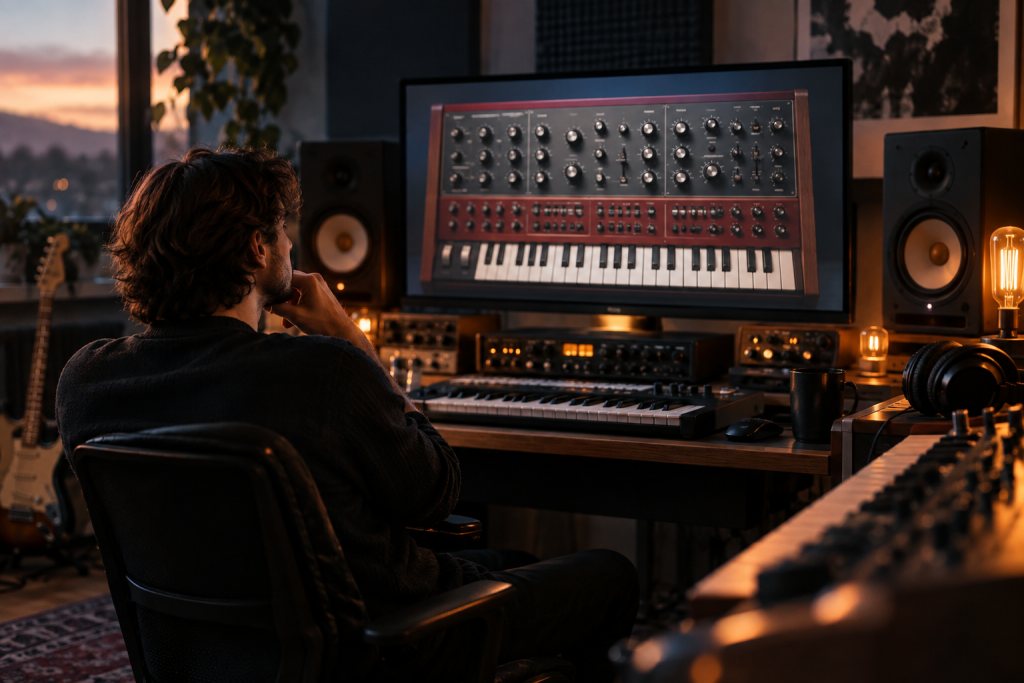
There’s a specific moment every producer knows: you’ve got a chord progression that works on paper, but it sounds like cardboard coming out of your DAW. You reach for a different synth, and suddenly the same three notes feel like they’re breathing. That’s the Diva test. u-he‘s virtual analog flagship has been out for years, and it’s still the plugin I reach for when a pad needs to feel like it’s coming off a well-maintained piece of 1980s hardware rather than a CPU.
This isn’t a synth that wows you on the spec sheet. It wows you when you’re two hours into a session and realize the low end on your pad has actual texture instead of a smeared sub. Let’s get into why, and where the tradeoffs bite.
What Diva Actually Is
Diva is a virtual analog synth built around component-level circuit modeling. According to Syntorial, u-he uses PSpice to model the old analog circuitry down to individual components, the same approach used in a SPICE simulator for electrical engineering. That’s the technical core of why it sounds the way it does. The upside is zero-delay feedback on the filter response, which is what makes resonances sound crisp rather than smeared or digital.
What that means in practice: when you crank the filter resonance on a Diva patch, it doesn’t spike into that thin, whistling, “oh that’s clearly a plugin” territory. It holds together. The filter behaves like a real ladder filter being pushed.
The synth is semi-modular in spirit. It’s not a modular patchbay, you’re not dragging cables, but you’re assembling a signal path from a menu of classic building blocks. That’s where the name earns its keep.
The Sound Sources: Five Decades in One Plugin
Diva impersonates a specific set of classic hardware. According to the Syntorial breakdown, that list includes the Roland Juno 60, the Jupiter 6 and 8, the Minimoog, the Oberheim OB8, and the Roland JP-8000. That’s a deliberately chosen roster, it spans early polysynth warmth, mono bass weight, and the bright, glassy character of late-90s digital-adjacent analog.
The architecture gives you 5 oscillator models and 5 filter models, with multiple filter types inside each. You can mix and match. The classic move, and one that Syntorial explicitly calls out, is taking the oscillators from a Minimoog and pairing them with the filters from a Korg MS-20. That combination isn’t available in any single piece of hardware, and it’s exactly the kind of hybrid that makes Diva interesting years after purchase.
On top of that you get 2 host-sync LFOs with multiple waveforms and 2 stereo effect slots. The effect slots cover chorus, reverb, phaser, rotary speaker, and delay. These aren’t throwaway, the chorus and phaser in particular are usable as sound-design tools on their own, and the rotary speaker is a nice touch for anyone doing organ-adjacent textures.
Why This Matters for Pads Specifically
Pads are where virtual analog synths go to die. A soft pad exposes everything, thin oscillators, sterile filters, aliasing on the high end. Diva’s component-level modeling is most audible when you’re holding long, evolving chords, because that’s when small nonlinearities in the oscillators and filters have time to interact.
If you’re layering a Diva pad under a mix, the thing you’ll notice first is that it sits in the frequency range instead of floating above or below it. Warm analog pads have a way of occupying the midrange with body rather than just carving out space with an EQ scoop.
The CPU Reality
Here’s the honest part: Diva is CPU-heavy. Syntorial is direct about this, the component modeling that makes it sound the way it does comes at a real processing cost. There’s a multicore option inside that spreads the load across more than one processor core, and it helps, but it doesn’t make Diva cheap.
My practical advice: freeze your Diva tracks once you’ve committed to a patch. Don’t leave six instances running in a dense project and then complain the audio is crackling. If you’re on a laptop, budget the CPU the way you’d budget it for a heavy convolution reverb. One or two instances is fine. Twenty is a mistake.
The multicore button is worth leaving on by default. It won’t work miracles, but it moves the ceiling up enough to matter when you’re balancing a full arrangement.
The Presets Are Genuinely Good
Most synths ship with 300 presets and you use four of them, all of which you tweak immediately. Diva ships with over 1200 presets, and Syntorial is unusually enthusiastic about them, calling them the best presets they’ve heard inside a softsynth, and noting they avoid the stale trap and dubstep template sounds that fill other libraries.
I’d mostly agree. The Diva library skews toward usable, musical starting points, pads, basses, keys, leads, rather than demo-bait. Even if you’re a sound designer who builds from init, the preset browser is a good place to hear what the oscillators and filters can do before you start patching cold.
Diva vs. the Free Alternatives
If you’re reading this and wondering whether to spend money on a synth when free options exist, that’s a fair question. There are legitimately excellent free virtual analog synths in 2026.
OB-Xf by the Surge Team is a faithful emulation of the Oberheim OB-X, and it delivers lush pads and thick 80s leads with real character. According to Born to Produce, it started from the same codebase as OB-Xd (which has since gone paid) and continues as a free, open-source project. If you specifically want the Oberheim pad sound, OB-Xf is a serious contender and costs nothing.
Podolski, also by u-he, is the stripped-back one-oscillator sibling. Born to Produce describes it as prioritizing sound quality over feature count, warm, characterful sounds with minimal fuss. If Diva is too CPU-heavy or too expensive, Podolski is the same design philosophy with the fat trimmed off.
So why pay for Diva? Because the multi-model architecture is the point. OB-Xf gives you one classic. Podolski gives you a clean, simple mono. Diva gives you five oscillator models and five filter models that you can cross-wire into sounds that don’t exist on any single piece of hardware. That flexibility is what separates it from the free tier, and it’s why the CPU hit is worth tolerating.
Where Diva Sits in a Modern Setup
I don’t use Diva as my only synth. I use it for the jobs it’s best at: warm analog pads, thick poly chords, rounded mono basses, and the occasional lead that needs to cut without being harsh.
For pads, it’s my first call. Load an OB8-ish patch, swap the filter to something brighter, add a touch of the built-in chorus, and you’ve got a bed that holds a track together instead of just filling space. The hybrid oscillator-filter combinations mean you’re not stuck with “the Juno sound” or “the Moog sound”, you get a palette.
For basses, it’s excellent but CPU-hungry, so I’ll usually commit and freeze early. For leads, it’s more than capable, the filter models have enough bite for aggressive tones when you want them.
Who Should Buy It
Diva is for the producer who has a soft spot for classic analog character and wants that character without buying, maintaining, and tuning hardware. It’s for the person who understands that “warm” isn’t a marketing word but an actual quality of the oscillators and filters, and who’s willing to trade CPU for it.
It’s probably not for someone who needs 40 track polyphony across a dozen instances on a modest laptop, or someone who wants a modern wavetable or FM synth as their primary tool. Diva is a specialist. It does one thing, classic analog emulation, and it does it about as well as anything in software.
The Verdict
u-he Diva doesn’t chase trends. It doesn’t have a 50-slot mod matrix or a granular engine or a wavetable scanner. It has one job: sound like the analog synths that defined five decades of music, and give you the freedom to hybridize them. It nails that job.
The CPU cost is real, and you should plan around it. But when you’re sitting in front of a pad that actually moves, that has body and texture and a filter that responds like it’s made of capacitors and transistors instead of math, the tradeoff stops feeling like a tradeoff. If warm analog pads are what you’re after, Diva is still the answer, and it’s been the answer for years.