Three Free Delay Plugins for Building Tape-Style Echoes on Ambient Guitar Loops
Lucid Records
October 31, 2026
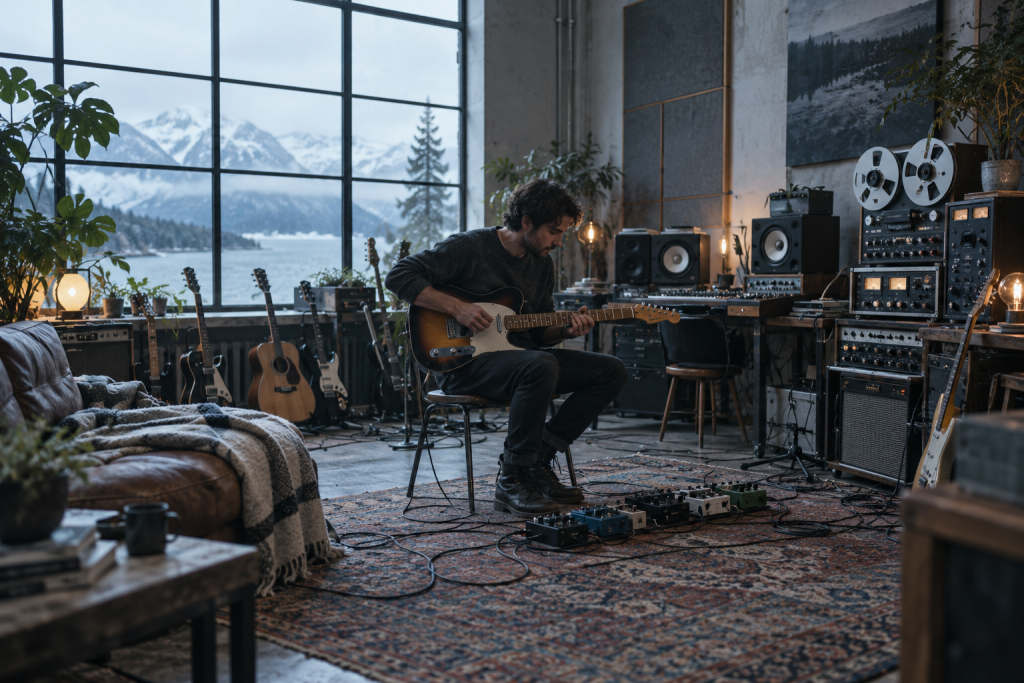
The loop is six bars long and it has been sitting on repeat for maybe twenty minutes while we fiddle with a pedal board that is not even plugged in. Somewhere in there a delay line starts to smear the repeats into a soft haze and the whole thing turns into the sound we were chasing. That is the ritual: guitar into interface, a chain of free plugins, and a little patience with feedback. Here are three free delays worth loading when you want echoes that feel like tape rather than a metronome.
None of these are technically tape emulations in the strict sense. Real tape delay means a physical medium, wow and flutter, and a head that wears out. What we mean here is the behavior tape gives you: repeats that darken as they decay, a feedback path that can bloom rather than clip, and enough diffusion that the tail becomes atmosphere instead of rhythm. Three free plugins get us close.
FRCTL DLAY Lite: the wash machine
DLAY Lite arrived in 2026 as a multi-tap delay for macOS, Windows and Linux, and it strips the interface down to two controls and a preset list. Mix and Wash. That is almost the whole story. The Wash knob is the character: turn it low and echoes stay tight and clear, turn it up and the repeats blur into something closer to a reverb cloud.
That is exactly what a guitar loop wants when you are building a bed under a sparse melody. We load DLAY Lite on a send, pick one of the longer presets, push Wash until the tail stops sounding like a repeat and starts sounding like room. Behind the two knobs the plugin arranges up to twelve echoes with timing, level and space controls, but the presets do the heavy lifting. The one annoyance is a button on the interface that points toward the paid full version, which expands to far more echoes plus pan, pitch, vowel shaping, saturation and reverse. Fair enough for a free tool, still mildly irritating in the middle of a session.
How we use it on a loop
Drop it on a send, keep Mix conservative, and let the dry guitar sit forward. When a phrase repeats too obviously, raise Wash instead of shortening the delay time. The blur does the disguising. If detailed tap programming is what you need, look elsewhere; but for a quick atmospheric echo on a send, it fits beautifully.
MKS Mixing DelayU-42: the grit and the darkening
DelayU-42 models a vintage rack delay from the 80s, and the developer does not name the original. The fingerprint is clear anyway: input saturation, an opto-limiter in the feedback path, and repeats that darken as they cascade because the filtering is modeled across the circuit. That last part matters enormously on ambient guitar. Each echo loses a little top end, so the tail sinks behind the dry signal rather than competing with it.
The controls are Power, Input, Output, Mix, Feedback and delay time. Time runs raw in milliseconds up to 4800 ms, or locks to host tempo in musical subdivisions. The Input knob drives the delay circuit hard, and the limiter reacts sooner as you push it. Push feedback toward self-oscillation and the opto-limiter smooths transients instead of letting the thing crash into digital clipping.
Our favorite misuse: feedback at zero, delay time at zero, Input pushed, and Mix blending in the saturation. DelayU-42 becomes a gritty color box. That trick is not why we reach for it on guitar loops, but it is why it stays loaded. The plugin ships as VST3 for macOS and Windows. Recent updates added denormal protection and DSP stability fixes, which sounds dull until a long feedback tail spikes your CPU in the middle of a take.
Circuit Haze Howl: three knobs, one pedal
Howl comes from a London developer and it collapses delay and reverb into a single feedback loop. Three knobs and a tone switch. That is the entire interface, and it is shaped like a guitar pedal rather than a plugin window, which suits the way guitarists actually think about this stuff.
For loop work the appeal is the merge. You are not choosing between an echo and a room; the feedback loop carries both, and the tone switch tilts the character. On a clean loop it can sound almost like a spring tank with a slapback in front. On a distorted phrase it turns into a smear. No tempo sync, no tap grid, no deep editing. It is a color, not a utility, and it runs on macOS, Windows and Linux.
We use Howl when a loop needs to sound like it was played in a space rather than processed in a DAW. Put it after a drive pedal, keep the delay short-ish, and let the reverb side fill the gaps between phrases.
What to reach for, and when
Each of these solves a different problem.
- DLAY Lite for a fast, wide atmospheric echo on a send. Wash is the reason to load it.
- DelayU-42 for echoes that darken and saturate. Best when the tail should sit behind the dry guitar instead of fighting it.
- Howl for a pedal-like delay-reverb blend with almost no setup. Best on a live-feeling loop.
We would not stack all three on one guitar. That is how a loop turns to mush. Pick one for the main tail, maybe a second for a contrasting send on a single phrase, and leave the rest alone.
The other piece of the tape feel is not in any plugin. It is in how you play into the delay. Let notes ring past the loop boundary. Leave a beat of silence before a chord so the tail has room. Slightly detuned repeats do more for atmosphere than any parameter. A loop that sounds dreamy on record usually got there because the player stopped fighting the echo and started writing for it.
All three are free, all three run on the major platforms, and none of them will replace a real tape machine. They do not need to. Load one, play six bars, and see if the room starts to breathe.