Circuit Haze Howl: A Free Three-Knob Delay and Reverb in One Feedback Loop
sapi_44530a
September 24, 2026
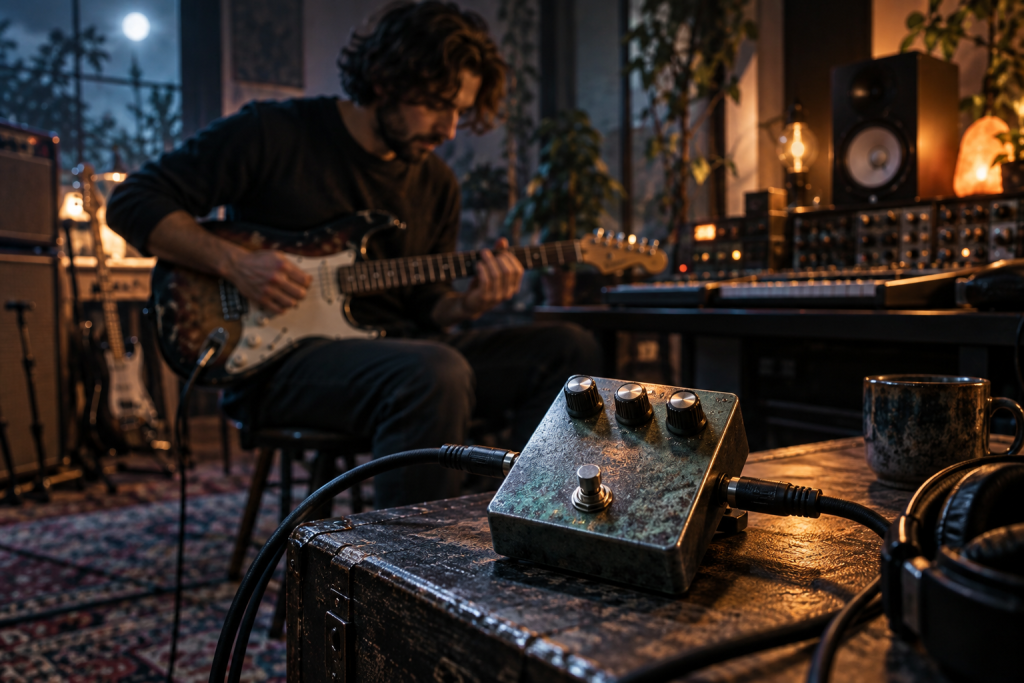
There’s a specific kind of delay that doesn’t sound like a delay. It sounds like a room that keeps misremembering what you played. Feed a chord in, and what comes back is a smear of the original, pitched somewhere between echo and reverb, half a beat behind the beat, darkening on every pass until it’s just breath. A lot of plugins chase that sound with ten knobs and a filter section. The interesting ones chase it with three.
That’s the appeal of the circuit-haze-and-howl school of delay design: instead of giving you separate controls for time, feedback, diffusion, damping, and mix, you get a small number of parameters that are deliberately coupled to each other. Turn one, and the whole feedback loop changes character, not just one aspect of it. If you’ve spent any time with free delay plugins lately, you’ve probably already met this idea without naming it. Here’s what’s actually happening under the hood, and how to use it.
Why fewer knobs can mean more range
Most delays are built as a straight line: input → delay line → filter → output, with feedback tapped off the delay line. Every control maps to one node in that chain. That’s readable and predictable, and it’s why a workhorse like Sirial from tiagolr can give you 16 serial delay lines, each with its own amplitude and feedback, plus saturation, diffusion, and damping, and still feel logical, you’re building a pattern, tap by tap, on a grid (Bedroom Producers Blog). More taps, more control, more decisions.
The three-knob school does the opposite. It bundles several of those nodes into single parameters so that the ratios between them move together. That’s not lazy design, it’s a design decision that produces sounds you can’t easily get by dialing independent controls, because the relationships between feedback, tone, and diffusion stay locked in a musical proportion as you sweep. The closest mainstream example is Valhalla Supermassive, which is free and built around exactly this premise: it’s best for enormous reverbs, has a delay circuit that specializes in huge feedback washes, and now ships with 22 combined reverb/delay modes (Attack Magazine). You don’t get a full delay editor. You get a mode, a few macro-ish controls, and a feedback path that blooms.
What a feedback loop actually does to harmonics
The reason these plugins sound hazy rather than simply loud is that each repeat is not a copy, it’s a filtered, slightly degraded copy of the previous one. DelayU-42 from MKS Mixing models this explicitly with cascaded filtering, where every repeat progressively darkens. The practical result, as BPB notes, is that the delay tail sinks behind the dry signal instead of competing for the same top-end space, useful on vocals and lead parts, where a bright delay tail fights the very thing it’s supposed to support.
Now add diffusion. Diffusion smears the transient of each repeat into a cloud, so the echo stops being a discrete event and starts being a texture. That’s the mechanism that turns a delay into what everyone loosely calls a reverb. DLAY Lite from FRCTL Audio makes this the entire point of one knob: its Wash control turns tighter, clearer echoes into a longer, smoother, more diffuse tail and pushes the delay toward a reverb-like cloud as you raise it (Bedroom Producers Blog). Two controls, twelve presets, done. That’s the whole plugin.
Feedback as a sound-design tool, not a mistake
Here’s where the howl comes in. In a digital delay, runaway feedback usually means clipping, a hard, ugly wall. Better-designed plugins put something in the feedback path to catch it. DelayU-42 uses a dual opto-limiter in the feedback path, which lets you push feedback into more aggressive territory, including self-oscillation, while smoothing transients instead of crashing straight into harsh digital clipping. It also added denormal protection to prevent CPU spikes, plus safer sample-rate allocation and DSP fixes in a recent update.
That combination, saturation plus limiting inside the loop, is what makes high-feedback settings usable as an instrument rather than a hazard. And it opens up a trick that has nothing to do with echo at all. Set DelayU-42’s feedback to zero, set delay time to 0 ms, push the Input, and blend with Mix, and you get the limiting and saturation character without any traditional delay. The Input control drives signal into the delay circuit; push it harder and you get more saturation, with the modeled opto-limiter reacting sooner. Mix isn’t a dry/wet balance so much as a character amount, it affects how much of that limiter and saturation color is present in the output, so the analog-style grit stays active even at low mix settings. That’s a free saturation box hiding inside a delay.
Ducking: the unglamorous fix that makes big tails usable
Big feedback washes have one enemy: your vocal. The moment a long tail overlaps a phrase, intelligibility drops. This is why so many modern reverbs build ducking in rather than making you set up a sidechain. VELA, for instance, integrates ducking to keep reverb out of the way until it’s needed, and pairs it with a de-esser that smooths harsh sibilance before it hits the reverb tail, cleaner ambience, fewer harsh S sounds bouncing around the room (PluginErds). iZotope Aurora takes a similar instinct in a different direction with adaptive unmasking that reacts in real time to clear frequency clashes automatically, so you’re not EQ-ing the reverb or stacking plugins to control mud.
Sirial does it too, with a ducking section offering threshold, attack, and release. If your three-knob delay doesn’t have ducking, the classic workaround still applies: put the delay on a send, then automate the send level down a touch under lead lines. Tedious, but it works. If it does have ducking, use it before you reach for EQ, you’ll usually need less of both.
How I’d actually patch one of these
- Start with the mode, not the knobs. On Supermassive-style plugins, the 22 modes cover wildly different ground, tight slaps through to infinite washes. Audition modes at a fixed feedback setting first, then dial.
- Push feedback until it just starts to bloom, then back off 10%. The limiter in a good feedback path will save you from disaster, but the sweet spot is always just below where it takes over.
- Use damping as arrangement. A tail that darkens on every repeat naturally recedes. On a dense mix, that’s free space you don’t have to carve with a high-shelf.
- Try it as a pad generator. Supermassive can turn any sound into a pad, which is the same mechanism as the wash trick, long, diffuse feedback with heavy damping. Feed it a single piano note and hold.
- Use the saturation-only trick. Zero feedback, zero delay time, hot input. Instant grit on a drum bus, and it costs nothing.
- Duck it on vocals. Threshold, attack, release, if it’s there, use it. If it isn’t, automate the send.
Where this sits next to the bigger tools
Nothing here replaces a proper reverb with real control over decay, density, and damping over time, or the node-based approach VELA uses to let you shape how reflections bloom and fade. And it doesn’t replace a rhythmic multi-tap delay where you’re drawing an actual pattern. What it replaces is the moment where you want one gesture, more haze, less definition, and you don’t want to open a plugin with forty parameters to get it.
The trade-off is real: fewer knobs means less precision, and precision matters when a delay has to lock to a rhythmic subdivision. Sirial is the better tool for that job, with 16 serial taps, stereo and ping-pong modes, a reverse mode, and host-BPM sync with selectable subdivisions. But for atmosphere on a send, or for turning a dry synth line into something that breathes, a three-knob feedback loop is faster to a usable result than almost anything with a full editor. Free makes the decision easy. Try it on a send, push the feedback until it howls, and pull back.