Why We’re All Making Slow Music Again: Notes on the New Downtempo
sapi_44530a
September 18, 2026
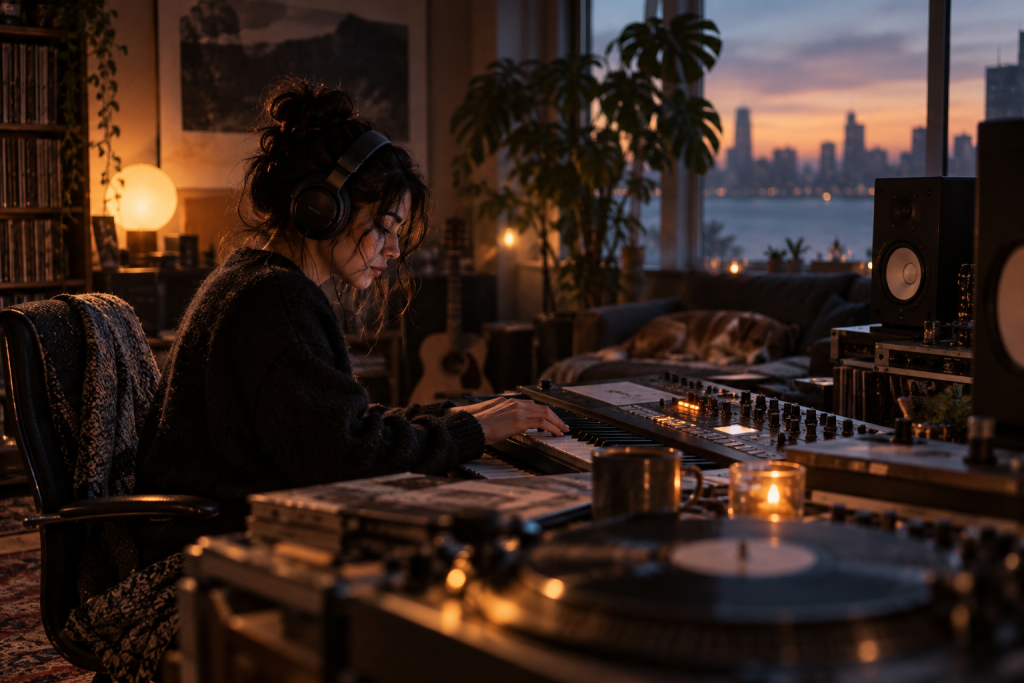
Something shifted in the last couple of years, and I don’t think it’s just my feed. The tracks that actually hold my attention, and, judging by what’s charting in ambient and downtempo corners of the internet, a lot of other people’s too, are getting slower, longer, and less interested in grabbing you in the first ten seconds. After a decade of producers optimizing for the skip button, the pendulum is swinging back toward music that asks you to sit still. This piece is about why that’s happening, and what it means if you’re the one making it.
The compression era and what it did to our ears
Let’s be honest about the pressure that shaped the last ten years of production. The most heavily streamed tracks are straight to the point: the chorus sometimes arrives before the first 20 seconds, intros disappear, and even the fade-out feels like it belongs to another era. On TikTok, Instagram Reels, and YouTube Shorts, a song no longer necessarily exists as a complete work, it exists as an immediately identifiable extract, and fifteen seconds can be enough to turn a track into a viral phenomenon.
The economics reinforced the aesthetics. On Spotify, a stream is counted after roughly 30 seconds of listening, so two two-minute songs played back to back can generate more streams than a single four-minute track, and if the algorithm sees a high play rate, that track is far more likely to surface in auto-generated radio stations and playlists. When revenue depends on stream counts, that logic seeps into the writing itself. You start building around the hook, not the arc.
But blaming the platforms wholesale is a cop-out. Every era has shaped its formats: vinyl limited how much music fit on a side, radio imposed its own standards, MTV changed how we thought about songs entirely. The platforms redistributed attention; they didn’t invent short music. And here’s the interesting part, the same infrastructure that rewards the fifteen-second hook also makes room for its opposite.
Why slow is winning again
In 2021, Taylor Swift’s ten-minute version of “All Too Well” became the longest song in history to hit number one on the US Billboard charts. That’s a genuine counter-current to everything the streaming era supposedly demands. Kendrick Lamar and Tyler, The Creator keep building tracks where moods change, productions branch off, and narratives take their time. And on the electronic side, ambient’s current success, long ascents, hypnotic repetition, instrumental passages that stretch past ten minutes, is almost the norm rather than the exception.
The paradox is that streaming encourages this diversity too. In the heyday of FM radio, a track had to fit a precise format to get airtime. Today a 12-minute techno loop and a 1:40 TikTok hit can sit in the same playlist without either looking out of place. The gatekeepers lost their grip, and what filled the gap wasn’t just shorter music, it was weirder music, including the very long stuff.
There’s a human reason underneath the algorithmic one. Online platforms have accustomed our brains to fast, immediately gratifying, constantly renewed content, and a lot of us are quietly exhausted by it. Fragmented listening, in transit, while scrolling, between two notifications, turns a song into just another piece of content in a continuous flow. Long intros à la Pink Floyd and slow builds à la LCD Soundsystem become almost counter-cultural in that context. Which is precisely why they feel like relief.
And at the end of the day, the real challenge was never duration. It’s what you can do with the time you devote to what you love. Ten minutes of slow build isn’t better than two minutes of pop, but it’s a different contract with the listener, and more people are signing it again.
The production implications, without the nostalgia trip
If you’re writing slower music, the rules you internalized for the streaming era work against you. A few things I’ve found matter more than usual:
- The intro is the whole game now. When a track runs eight to twelve minutes, the first ninety seconds have to establish a world, not a hook. Textures, space, and a sense of place do that better than a melody statement.
- Repetition has to earn its keep. Hypnotic doesn’t mean static. Subtle modulation, filter movement, reverb tails lengthening, a pad drifting a few cents sharp, keeps a loop alive without breaking the trance. This is where granular and spectral tools genuinely earn their place, because they let a single source keep evolving.
- Arrange in sections you’d actually want to listen to. With no chorus to hang on, the structure carries the weight. Let a section run long enough to feel like a room, then move the floor.
- Dynamics are your only punctuation. When everything is saturated, nothing is loud. Slower music lives and dies on restraint, pulling elements out is usually stronger than adding them in.
None of this is an argument that you need vintage gear to make slow music. But there’s a related shift worth noting, because it feeds the same impulse: a lot of producers are rediscovering hardware not out of nostalgia but out of screen fatigue. Spending all day in front of a computer for work, messages, and social media makes staying on the same platform to compose genuinely tiring. Turning a knob and sculpting a sound without going through a software interface changes the experience, and the pleasure, of making the track.
Hardware also forces commitment in a way that suits slow music. In a DAW, the temptation to change every parameter up to the last minute is always there, you can tweak a synth’s color when the song is basically finished. With a machine, unless you’re recording everything as MIDI, laying down a take freezes the sound. You’ve made a choice, and you move forward. That commitment shifts how you think about a piece’s structure: you build successive layers, each with its own identity, definitive and assumed, rather than endlessly re-litigating the same five bars.
The trap on the other side
Here’s where I’d push back on the romance a little. The return to slow also carries a risk of overabundance. We live in an age of infinite choice, and owning ten thousand sounds is no guarantee of finishing a single piece, it’s often the opposite, a direct path to paralysis. The producers making the best long-form downtempo right now tend to work the other way: they commit to a limited palette, learn it deeply, and accept its universe, its filters, and its limits rather than skimming through a thousand presets. That deliberate simplicity lets you focus on the essentials, melody, rhythm, and emotion, which is exactly what carries a ten-minute track.
There’s also a tactile argument that’s hard to quantify but real. A hardware instrument isn’t just a sound generator in a box; it has a presence and a response that push you in directions a mouse won’t. One function per button breeds a spontaneity that software still struggles to match, and the ergonomics encourage exploration by accident, you turn a knob out of curiosity and find a texture you weren’t looking for. Those moments of serendipitous discovery are rarer in the virtual world, where it’s easy to stick to the beaten path. You develop muscle memory, and the machine stops being a library of sounds and starts being a playing partner.
What this means if you’re making it right now
I don’t think we’re witnessing a rejection of pop or a moral victory for the ten-minute track. What’s happening is closer to a rebalancing: after years of format-driven compression, there’s an audience, a real, sizable, algorithmically-rewarded audience, for music that takes its time. The platforms didn’t create that audience out of nothing; they just stopped actively working against it.
So if you’ve got a sketch sitting at eight minutes that every instinct says to cut down to three, sit with it a while longer. Slow music is only counter-cultural until enough people decide they want their time back. And from where I’m sitting, that decision is already being made, in ambient playlists, in long techno sets, and in the growing pile of producers who’d rather sculpt one evolving world than chase a hook that dies in fifteen seconds.